
How to Create the Perfect H1 Tag for SEO
When it comes to search engine optimization, small details often make a big difference. One of the most important yet commonly overlooked elements is the H1 tag.
Your H1 tag is the main heading of your page. It tells both users and search engines what your content is about. When crafted correctly, it can improve rankings, increase engagement, and help guide visitors through your page.
Here is how to create the perfect H1 tag for SEO.
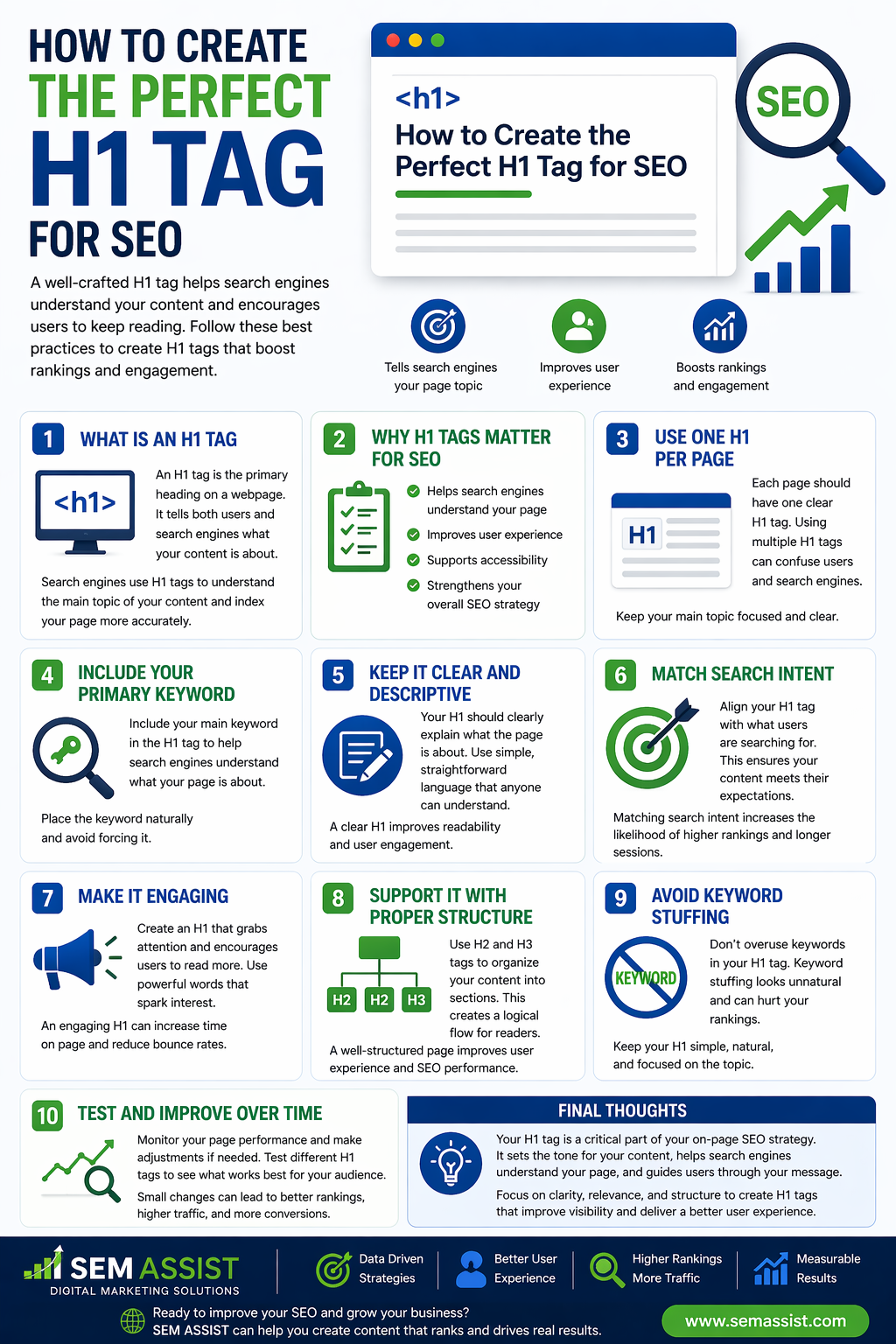
What Is an H1 Tag
An H1 tag is the primary heading on a webpage. It is typically the first thing users see when they land on your page and it plays a key role in content structure.
Search engines like Google use H1 tags to understand the main topic of your content. A clear and relevant H1 helps search engines index your page more accurately.
Why H1 Tags Matter for SEO
Your H1 tag serves multiple purposes.
It helps search engines determine the focus of your page. It improves user experience by clearly introducing the topic. It also supports accessibility by helping screen readers understand the structure of your content.
A well optimized H1 can strengthen your overall SEO strategy.
Use One H1 Per Page
Each page should have one clear H1 tag.
Using multiple H1 tags can create confusion for both users and search engines. A single, focused heading ensures that your main topic is clearly defined.
Think of your H1 as the title of your page. It should represent the core idea of your content.
Include Your Primary Keyword
Your H1 tag should include your main keyword.
This helps search engines understand what your page is about and improves your chances of ranking for that term. Place the keyword naturally within the heading rather than forcing it.
A keyword focused H1 strengthens your relevance in search results.
Keep It Clear and Descriptive
Clarity is essential when writing your H1 tag.
Your heading should immediately tell users what they can expect from your page. Avoid vague or overly complex wording.
A clear and descriptive H1 improves both readability and engagement.
Match Search Intent
Your H1 tag should align with what users are searching for.
If someone is looking for information, your H1 should reflect that. If they are looking for a solution, your heading should guide them in that direction.
Matching search intent increases the likelihood that users will stay on your page.
Make It Engaging
While your H1 should be optimized for SEO, it should also capture attention.
Use language that encourages users to continue reading. A compelling heading can increase time on page and reduce bounce rates.
Balance optimization with creativity to create a strong first impression.
Support It With Proper Structure
Your H1 tag should work alongside other headings on your page.
Use H2 and H3 tags to break down your content into sections. This creates a logical flow that is easy for users to follow.
A well structured page improves both user experience and SEO performance.
Avoid Keyword Stuffing
Including your keyword is important, but overusing it can hurt your results.
Keyword stuffing makes your content look unnatural and can reduce readability. Keep your H1 simple and focused.
Search engines understand context, so there is no need to repeat keywords excessively.
Test and Improve Over Time
Like other SEO elements, your H1 tag can be optimized over time.
Monitor your performance and make adjustments if needed. Small changes can lead to better rankings and higher engagement.
Continuous improvement helps you stay competitive.
Final Thoughts
Your H1 tag is a critical part of your on page SEO strategy. It sets the tone for your content, helps search engines understand your page, and guides users through your message.
By focusing on clarity, relevance, and structure, you can create H1 tags that improve both visibility and user experience.
At SEM ASSIST, we help businesses optimize every element of their content to drive better results and long term growth.
Ready to Improve Your SEO Strategy
If you want to enhance your website performance and create content that ranks, SEM ASSIST can help you build a strategy that delivers measurable results.